

The Chalice Well: Sacred Spring, Ancient Symbol, and Modern Talisman
Nestled at the foot of Glastonbury Tor in Somerset, England, the Chalice Well is one of Britain’s most enigmatic and spiritually resonant sites. For centuries, its rust-red waters—stained by iron oxide—have drawn pilgrims, seekers, and mystics who believe the spring holds profound healing and transformative powers. Surrounded by lush gardens and ancient yew trees, the well is both a natural wonder and a focal point of legend, blending Celtic, Christian, and esoteric traditions. At its heart lies the iconic Chalice Well cover, a wrought-iron lid forged in 1919, featuring two interlocking circles pierced by a bleeding lance—a design that has become the emblem of the site and the inspiration for thousands of pieces of jewelry worn worldwide.
The Legend of the Holy Grail
The Chalice Well’s fame is inseparable from its association with the Holy Grail—the cup said to have caught Christ’s blood at the Crucifixion. According to medieval Arthurian romance, Joseph of Arimathea brought the Grail to Britain after the Resurrection, hiding it in a well at the base of Glastonbury Tor. Local tradition claims the Chalice Well is that very spring, its iron-rich waters symbolizing the blood of Christ. The red hue, caused by natural chalybeate (iron-bearing) deposits, is seen by believers as a physical manifestation of sacred blood, a perpetual miracle.
This legend gained traction in the 12th century when monks at Glastonbury Abbey—desperate for pilgrimage revenue—promoted the town as “Avalon,” the mystical isle of Arthurian myth. Though historians debate the Grail’s historicity, the story endures. For many, the well is not just a Christian relic but a pre-Christian sacred site, possibly linked to Druidic or Goddess worship.
A Pre-Christian Sanctuary?
Archaeological evidence suggests the area around the Chalice Well was revered long before Christianity. Iron Age artifacts, including votive offerings, have been found nearby, and the spring’s consistent flow—approximately 25,000 gallons per day—would have made it a vital resource in ancient times. Some scholars link it to Celtic water cults, where springs were seen as portals to the Otherworld. The name “Chalice” may itself be a Christian overlay; older records refer to it simply as the “Red Spring” or “Blood Spring,” hinting at pagan blood rituals or earth-based fertility rites.
The Vesica Piscis—the interlocking circles on the well cover—further bridges traditions. In sacred geometry, this shape represents the union of heaven and earth, spirit and matter, or male and female principles. Early Christians adopted it as a symbol of Christ (the fish), while esoteric traditions see it as the “womb of creation.” The bleeding lance evokes both the Spear of Longinus and phallic symbolism, making the design a powerful synthesis of dualities.

The Well Cover: From Practical Lid to Global Icon
The current well cover was designed in 1919 by Frederick Bligh Bond, an architect and psychic who claimed to communicate with Glastonbury’s monastic spirits. Bond’s design replaced a plain stone slab and was intended to protect the spring while honoring its mystical heritage. The Vesica Piscis, crafted in wrought iron, allows water to flow through while symbolically “bleeding” into the pool below. The cover’s beauty and layered meaning quickly made it the site’s defining image.
In the 1970s, as the New Age movement flourished, the Chalice Well Trust began selling replicas of the design as pendants, rings, and earrings. Crafted in silver, gold, or bronze, these pieces became talismans for spiritual seekers. Today, the symbol appears on everything from mass-produced Etsy charms to hand-forged artisanal jewelry, worn by pagans, Christians, yogis, and celebrities alike.
Glastonbury Chalice Well Jewelry
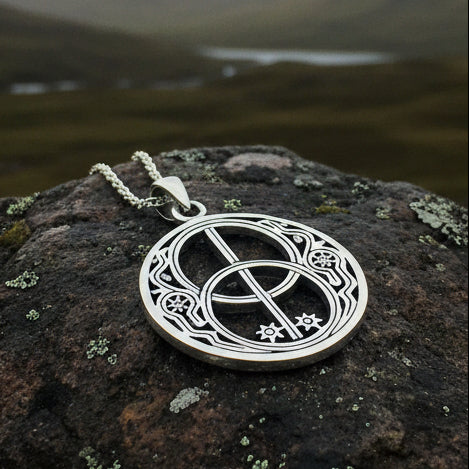
Glastonbury Chalice Well Necklace in Sterling Silver
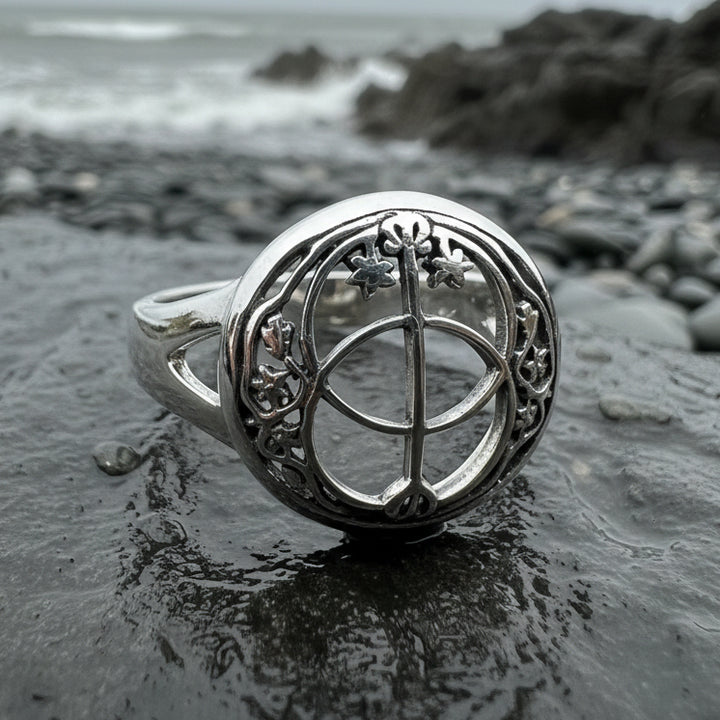
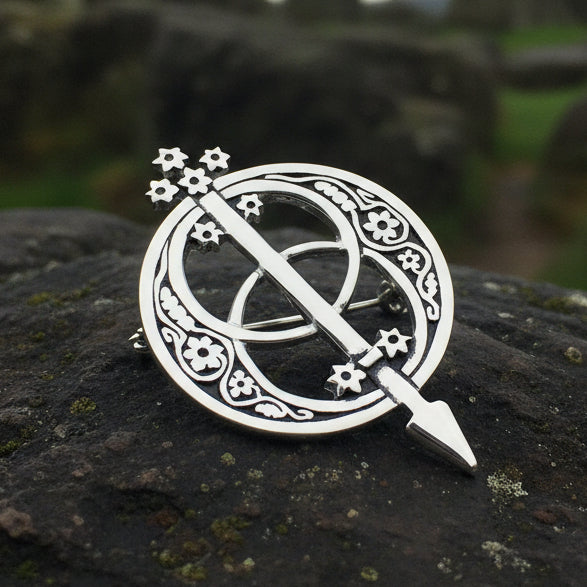
Why People Wear Chalice Well Jewelry
- Connection to Sacred Feminine Energy Many wearers—especially women—see the Vesica Piscis as a symbol of the divine feminine, the womb, and creative life force. The well’s association with Mary Magdalene (in esoteric traditions, the “Grail bearer”) and the Goddess further amplifies this. Jewelry serves as a portable altar, a reminder of inner divinity.
- Healing and Protection The red waters are believed to carry healing properties, particularly for blood-related conditions, fertility, and emotional wounds. Wearing the symbol is thought to channel this energy, acting as a protective amulet.
- Spiritual Lineage and Pilgrimage For those who’ve visited Glastonbury, the jewelry is a tangible link to a transformative experience. It marks membership in a global community of seekers who share the well’s ethos of peace, unity, and ecological reverence.
- Aesthetic and Symbolic Versatility The design’s elegance appeals beyond spirituality. Minimalist and timeless, it suits both bohemian and understated styles.

Key takeaways
- The Chalice Well symbol carries themes of healing, renewal, and spiritual connection.
- Readers drawn to sacred symbolism often respond to meaningful talisman-style jewelry.
- Product bridges should stay subtle and match the article's reflective tone.
Key Takeaways
- This guide explores the chalice well: sacred spring, ancient symbol, and modern talisman: its history, symbolism, and cultural significance.
- Discover handcrafted Celtic jewelry pieces that bring these ancient traditions to life.
- Browse our collection to find a meaningful piece that connects you to Celtic heritage.
A Living Symbol in a Modern World
In an era of spiritual eclecticism, Chalice Well jewelry transcends dogma. A Wiccan might wear it for lunar rites, a Christian for devotion to the Grail, a secular environmentalist for its earth-honoring ethos. The symbol’s power lies in its ambiguity—it invites projection, interpretation, and personal myth-making.
The well itself remains a place of quiet pilgrimage. Visitors drink the water, meditate by the lion’s-head fountain, or leave clooties (prayer rags) in the yew trees. The jewelry extends this practice into daily life, a wearable whisper of Glastonbury’s magic. As one wearer told the Trust, “It’s like carrying a drop of the red spring against my heart.”
Whether viewed as historical curiosity, pagan shrine, or Christian relic, the Chalice Well endures as a testament to humanity’s thirst for meaning. Its jewelry—small, gleaming, and potent—ensures that the mystery flows far beyond Somerset’s green hills, into the pulse of the world. Explore Celtic jewelry today to express the deeper meaning in your life.

